
Key Takeaways
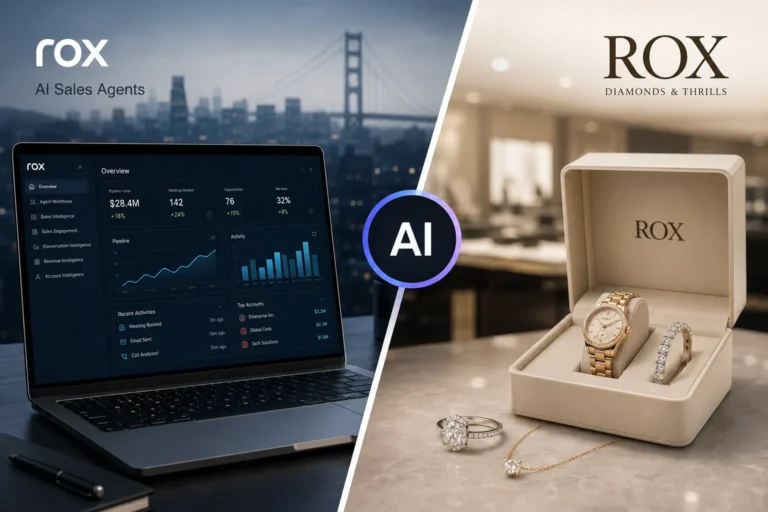
- Rox.com is not an online shop. It’s the website of Rox (legally Rox Data Corp.), a San Francisco-based AI startup that builds autonomous sales agents for enterprise revenue teams.
- The real “products catalog” on rox.com is a set of software modules, Agent Workflows, Sales Intelligence, Sales Engagement, Conversation Intelligence, Revenue Intelligence, and Account Intelligence, not physical goods.
- Rox was founded in 2024 by Ishan Mukherjee, the former chief growth officer of New Relic, and had raised $50 million by November 2024 from Sequoia, General Catalyst, and GV before reaching a $1.2 billion valuation, according to TechCrunch’s reporting.
- Documented customers include MongoDB and Cloud Software Group, per case studies published on Rox’s own site, while Ramp and New Relic are cited in TechCrunch’s coverage.
- A completely different company, ROX Diamonds & Thrills, sells luxury jewelry and watches in the UK, but its website is rox.co.uk, not rox.com, a distinction several online articles get wrong.
What Is Rox.com? Really?
If you searched rox.com’s products catalog expecting a shopping page full of clothes, gadgets, or jewelry, you’re not going to find one, and it’s worth explaining why so many search results suggest otherwise.
Rox.com’s own homepage describes the company plainly: “The Rox agent generates pipeline, qualifies leads, books meetings, manages deals, and expands accounts, all on autopilot,” positioned as being “Built for the Global 2000.” This is business-to-business software, sold to sales, revenue operations, and go-to-market teams at large companies, not a consumer marketplace. There’s no checkout cart, no shipping page, and no product category filters for clothing sizes or skin types, despite what several recent blog posts about “the rox.com products catalog” claim.
The confusion is understandable at a glance. “Products catalog” is a phrase normally associated with retail, and a wave of recent articles, several of which contradict each other on basic facts, have leaned into that assumption rather than checking the actual site.
Breaking Down the Real Rox.com Products Catalog
Rox organizes its platform around a set of AI agent capabilities rather than product SKUs. Based on the structure of Rox’s own website, the core modules are:
| Module | What it actually does |
|---|---|
| Agent Workflows | Lets teams direct AI agents with natural-language prompts to handle multi-step sales tasks |
| Sales Intelligence | Surfaces account-level research, such as recent leadership hires or technology stack changes, to prep reps before outreach or meetings |
| Sales Engagement | Finds prospects matching a defined profile and drafts personalized outreach sequences automatically |
| Conversation Intelligence | Records, transcribes, and analyzes sales calls to extract insights and next steps |
| Revenue Intelligence | Tracks pipeline value, deal stages, and rep-level performance across an organization’s accounts |
| Account Intelligence | Builds structured profiles of buying contacts and stakeholders within target companies |
These modules are aimed at replacing fragmented point solutions that sales teams previously stitched together. The company’s positioning explicitly contrasts this with retrofitting AI onto existing CRM platforms like Salesforce or HubSpot, aiming instead for a unified system that plugs into those tools rather than replacing them outright.
Who’s Behind Rox, and How Big Is the Company?
Rox was founded in 2024 by Ishan Mukherjee, who previously served as chief growth officer at New Relic following its 2020 acquisition of Pixie, a software monitoring startup he co-founded, according to TechCrunch. By November 2024, the company had raised a combined $50 million across a seed round led by Sequoia Capital and a Series A led by General Catalyst, with participation from GV, Google’s venture arm.
TechCrunch later reported that Rox closed a subsequent funding round valuing the company at $1.2 billion, again led by General Catalyst, with the company projected to end 2025 at roughly $8 million in annual recurring revenue at the time of that raise. Rox’s own site lists documented case studies with MongoDB and Cloud Software Group, while TechCrunch’s reporting separately names Ramp and New Relic among the company’s customers.
The company’s leadership team, listed on its own site, includes Shriram Sridharan as cofounder and CTO and Diogo Ribeiro as cofounder and CGO, alongside Stanford computer scientist Christopher Ré serving as cofounder of research.
Is Rox.com the same company as ROX Jewellers?
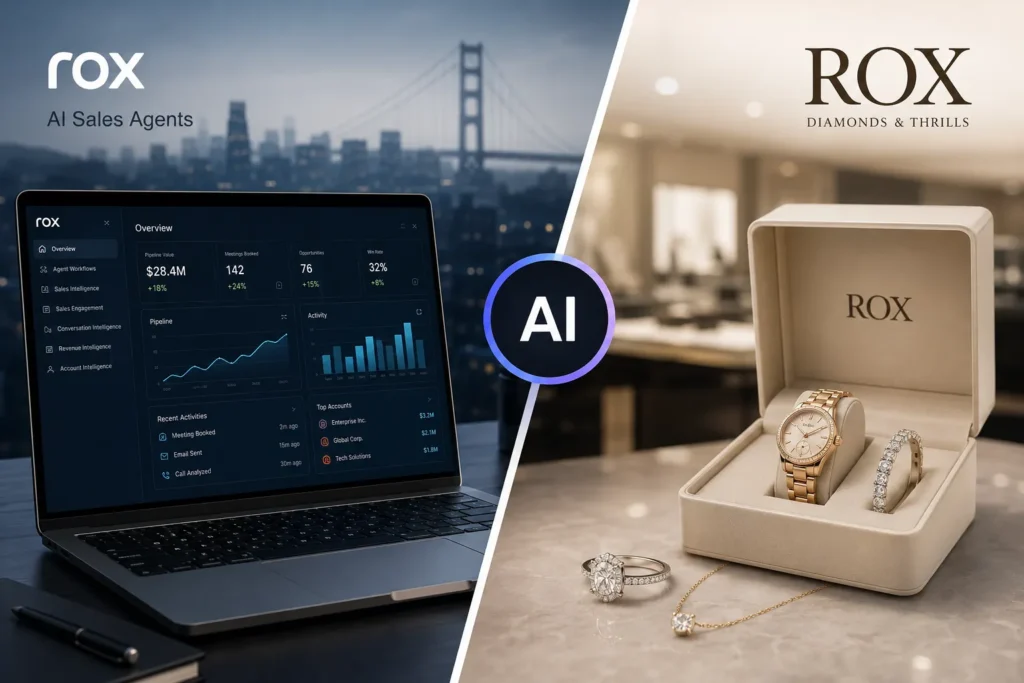
No, and this is where a lot of the online confusion actually originates. ROX Diamonds & Thrills is a genuine, well-established British jeweler, founded in 2002 by Kyron Keogh and Grant Mitchell, according to its Wikipedia entry. It operates roughly eight stores across Scotland and England, including flagship locations in Glasgow’s Argyll Arcade and Edinburgh’s Assembly Rooms, and stocks luxury watch brands, including Hublot, TAG Heuer, and Tudor.
Crucially, ROX Jewellers’ website is rox.co.uk, a completely separate domain from rox.com. The two companies share a short, common brand name by coincidence, operate in entirely different industries, and are headquartered on different continents. Several of the “rox.com products catalog” articles currently ranking online appear to blend details from both companies, describing rox.com as selling diamonds and designer watches when that business actually operates under the .co.uk domain.
Why Do So Many Articles Describe Rox.com as a Fashion or Beauty Store?
This is worth addressing directly, because it’s the clearest sign of a broader pattern. A number of recent web pages describe the “rox.com products catalog” as covering fashion, electronics, beauty products, and home goods, complete with invented details like size guides, ingredient lists, and seasonal collections. None of that matches what’s actually on rox.com, and none of those articles cite a verifiable source for their claims.
This is a recognizable pattern in low-quality, high-volume SEO content: articles generated around a short, search-friendly brand name without the underlying research to confirm what the company actually does. When a name is short, memorable, and shared by more than one real business, as is the case with Rox, it becomes an easy target for that kind of filler content. Readers researching a company for business, investment, or journalistic purposes should treat primary sources, the company’s own site, funding reports from established outlets like TechCrunch, and its documented enterprise customers as more reliable than generic third-party explainer posts.
Is Rox Built for Enterprise Security Requirements?
For readers evaluating Rox as a potential vendor rather than just trying to identify the company, its own site states that customer data is encrypted in transit and at rest using AES-256 encryption and is not used to train general-purpose machine learning models. Rox states it maintains SOC 2 Type II compliance with annual third-party security audits, is GDPR compliant, and lists ISO 27001 certification as forthcoming. It also discloses integrations with Salesforce, HubSpot, Gmail, Microsoft Outlook, and Slack, alongside a published vulnerability disclosure policy for security researchers.
The Bottom Line
The rox.com products catalog isn’t a shopping list; it’s a lineup of AI sales agents built for enterprise revenue teams, backed by more than $50 million in early funding and a subsequent round that pushed the company’s valuation past a billion dollars. If you landed here expecting jewelry, fashion, or electronics, you were likely thinking of ROX Diamonds & Thrills at rox.co.uk, a legitimate but entirely unrelated UK retailer. For anyone actually evaluating Rox as a sales tool, skip the recycled explainer posts and go straight to the company’s own product, pricing, and security pages, or its documented case studies with customers like MongoDB, for details that are actually accurate.
5. FAQ Section
What does Rox.com actually sell?
Rox.com sells access to an AI-driven revenue platform for B2B sales teams, not physical products. Its core offerings are software modules covering sales intelligence, engagement, conversation analysis, and pipeline tracking.
Is Rox.com the same company as ROX the jewelry store?
No. ROX Diamonds & Thrills is a UK luxury jeweler founded in 2002, based at rox.co.uk. Rox.com is an unrelated American AI sales technology company founded in 2024. The similar name is coincidental.
Who owns Rox.com?
Rox.com is operated by Rox Data Corp, founded by CEO Ishan Mukherjee, a former chief growth officer at New Relic, alongside cofounders Shriram Sridharan and Diogo Ribeiro.
How much funding has Rox.com raised?
Rox raised $50 million by November 2024 across seed and Series A rounds led by Sequoia and General Catalyst and later closed a round valuing the company at $1.2 billion, according to TechCrunch.
Why do some websites describe the Rox.com products catalog as fashion or electronics?
Several low-quality articles online appear to conflate rox.com with the unrelated UK jeweler ROX or generate generic e-commerce descriptions without verifying what the company actually sells, a common issue with SEO content built around short, search-friendly brand names.
Read More: What Happened to Voddler.co.uk? The Streaming Brand’s Real History vs. What’s There Now